
Finding Residents in Indiana Records
Indiana has no single public roll of every person who lives in the state. Start with the county tied to an address or event, because assessors, recorders, clerks, and election offices keep different files in each county. A name search can begin with Indiana’s public court index or a voter’s own registration check. An address search usually begins with a county parcel card. For an older household, a library directory or newspaper index may be more useful than a current portal.
Use each result for the role it records. A tax card names an owner, not everyone in the home. A voter lookup confirms a registration record for the person searching, not a list of the block. Court and vital records have public fields and restricted fields. A directory entry can show a past address, but it does not prove that a person lives there now.
- Write down the county for the address, court case, or life event. Use the official Indiana county directory to find the right local office.
- For property, search the county assessor or auditor by address, parcel, or owner name. Treat the card as an ownership and tax record, not a household list.
- For a person, check the relevant state index, such as MyCase, IndianaVoters, or an eligible vital-record index. Narrow a common name with county, dates, and other lawful fields.
- For a past address, compare a deed with city directories, census records, and newspaper notices. Keep the year and the exact spelling for each match.
- If an online search stops, ask the custodian for a specific existing record or contact a library or archive for older material.
Indiana's Resident Records Offices
Indiana shares some search tools statewide, but many address and event records stay with a county custodian. The recorder indexes deeds and other instruments; the assessor or auditor keeps parcel and tax details; the clerk holds local court and marriage files. The county elections office handles voter-file requests and corrections. These offices do not combine their records into one resident list.
For state-level collections, the Indiana Archives and Records Administration (IARA) holds selected permanent records, while the Indiana Department of Health handles central vital-record orders. Local health departments provide walk-up service for events in their county. The links below route a researcher to the right statewide starting point; county contacts still depend on the place being searched.
Indiana State Archives
6440 E 30th Street
Indianapolis, IN 46219
317-591-5222
Indiana Vital Records Office
State orders and county walk-up service
Indiana Department of Health
866-601-0891
Indiana Vital Records
Indiana Elections Division
County voter registration offices
Use the county directory for local contacts
IndianaVoters self-check
Indiana Voter Portal
Indiana Parcel Records Show Two Addresses
A parcel card separates the property address from the owner mailing address. The first locates the land or building; the second is where tax notices go. An owner may use a different home, a business address, or a post office box, so the mailing line does not prove who lives at the property. A homestead deduction is a tax claim, not a current occupancy check.
The Indiana Department of Local Government Finance tax-bill search draws on county data and advises trying part of a street name or surname when formatting gets in the way. For a concrete model, the Marion County property-card search accepts parcel number, state parcel number, owner name, or an address suggestion. That interface is an example, not a statewide promise: each county maintains its own parcel system.
- Situs or property address
- The physical location assigned to a parcel.
- Owner mailing address
- The tax-notice destination, which may be elsewhere.
- Parcel number
- A county identifier that helps separate similar street addresses.
- Legal description
- The lot, subdivision, or surveyed land description used in recorded instruments.
For an Indiana residents directory search, keep both address fields with the parcel number. That makes it easier to compare a card with a deed without treating ownership as proof of residence.
Indiana Court Record Search in MyCase
MyCase searches public cases from Indiana courts using Odyssey. A party search needs a last name; first or middle name and date of birth can narrow it. The form also offers a sounds-like option for spelling variants, court and case-type filters, status, and filing-date ranges. A result can include the party role, case number, filing date, event history, public documents, and disposition.
Search carefully when a name is common. The Indiana courts’ MyCase search tips explain the name controls and the 1,000-result limit. Older converted cases may lack documents, and a CAPTCHA can appear. The clerk’s file remains the official court record; use the statewide court and clerk directory to reach the county that holds it.
| MyCase field | What to enter | How it helps |
|---|---|---|
| Party last name | Required for a party-name search | Begin with the filed spelling. |
| First or middle name | Optional | Narrow a same-name result. |
| Date of birth | Optional search filter | Can distinguish people; it is not fully shown in public results. |
| Sounds-like | Optional control | Find alternate spellings in the index. |
| Court, case type, status, dates | Optional filters | Limit a search to a place, case group, or filing span. |
Vital Records Have Indiana Rules
The Indiana Department of Health (IDOH) centrally records births from October 1907 and deaths from 1900. Earlier events are held locally, so contact the health department or county custodian where the event took place. Birth and death certificates are not open to every requester during the restricted period. Birth and stillbirth registrations become public after 99 years under Indiana Code 16-37-1-7.5, effective July 1, 2025; before then, an applicant must meet the direct-interest or qualifying-relationship rules.
IDOH ordering instructions describe mail, phone, approved online ordering, and local health department walk-up service. IDOH has no walk-in counter. The listed first-copy fees are $10 for a birth record and $8 for a death record, with an additional-copy fee of $4. A non-certified death record with the Social Security number redacted is public under state law. Use an index or obituary to identify an event, then follow the certificate rules for an official copy.
Marriage records before 1958 are mainly with the county clerk; IDOH holds central marriage data from 1958. Divorce files belong to the court or clerk where the case was filed, not IDOH. Adoption and paternity records have separate access paths. An empty public index does not show that no event took place.
Indiana Voter Lookup Is Personal
IndianaVoters.gov lets a voter check their own registration, polling place, ballot details, and county election contact. The form asks for first name, last name, date of birth, and the county of current registration; an Indiana driver’s-license number is optional. Names must match the record, and the portal says to leave off a suffix such as Sr. or Jr. A failed match can reflect spelling, a name change, county selection, or an inactive record.
This is a self-check, not a public street-by-street list. Indiana’s statewide electronic system serves all 92 counties, but full voter data is released through narrower statutory channels. Form VRG-24 routes qualifying computerized-data requests through a county voter-registration office, with requester categories, payment, and use rules. Restricted statewide copies redact date of birth and gender; Address Confidentiality Program records are withheld from public inspection.
Use the county election office to correct a record or ask about a specific request. A voter’s residence field can also lag a move, so it should not be treated as proof that the person occupies a parcel today.
Indiana Resident Search Results Need Review
A court search result is a pointer to a case, not an official finding about the person named. MyCase itself warns that online data can have errors or omissions and may not show every older filing or document. The result can help locate a clerk file, but a name match alone cannot establish identity, current address, or the outcome of a case.
Read the role, county, case type, dates, and later events together. Some records are confidential, sealed, expunged, juvenile, or tied to a protected person; those limits remain even when another search result is public. If the case matters to a family-history question, ask the county clerk which public document can confirm the event. This careful check is more useful than collecting several unverified name hits.
Current Indiana Resident Records
Current records in Indiana are split by purpose and custodian. The parcel roll can identify a titled owner; the voter portal answers an individual registration question; MyCase indexes public court cases; and a recorder index traces parties to a deed. These are different records, not interchangeable versions of a single Indiana residents directory.
Start with the record that fits the question, then confirm an important fact with its custodian. The table shows what each route can support and where its limits begin.
| Source | Who It Lists | Keeper | Access |
|---|---|---|---|
| Parcel and tax card | Titled owner, parcel, tax and value fields | County assessor/auditor; DLGF links to county data | County portal or office; coverage varies |
| Voter self-lookup | Registration status and polling details for the voter | IndianaVoters and county election office | Individual check; full files have statutory limits |
| Public court index | Party role, case events, status, and some documents | MyCase; county clerk holds official file | Public cases only; document access varies |
| Recorder index | Grantor, grantee, date, instrument, and legal description | Recorder in the county where land is recorded | Vendor, counter, or book access differs by county |
| Vital and history indexes | Selected life events, obituaries, directories, and cemetery entries | IDOH, Indiana Legacy, State Library, local libraries | Index access differs from certified-copy eligibility |
Use the assessor for ownership, not occupancy; use the voter portal for a voter’s own check; use the clerk for an official case file. A historical address chain is a separate task, covered in the Indiana city directory collections for older name and address entries.
Indiana's Public Records Have Limits
Indiana’s Access to Public Records Act (APRA), Indiana Code 5-14-3, generally allows inspection or copying of existing public-agency records, subject to exemptions. It does not make protected records public or require an office to create a new resident list. Voter files, vital records, sealed court material, juvenile cases, adoption records, and motor-vehicle data each have separate rules. The state Address Confidentiality Program gives eligible survivors a substitute address and a way to flag voter records as confidential.
Indiana’s Sex and Violent Offender Registry is a narrow public-safety resource, not a general index of everyone who lives nearby. The Indiana Department of Correction registry page explains what information it publishes and its public-information purpose.
The source image below shows that agency page. A registry result should be read within its stated scope and date, not used as a stand-in for a court file or broader resident search.
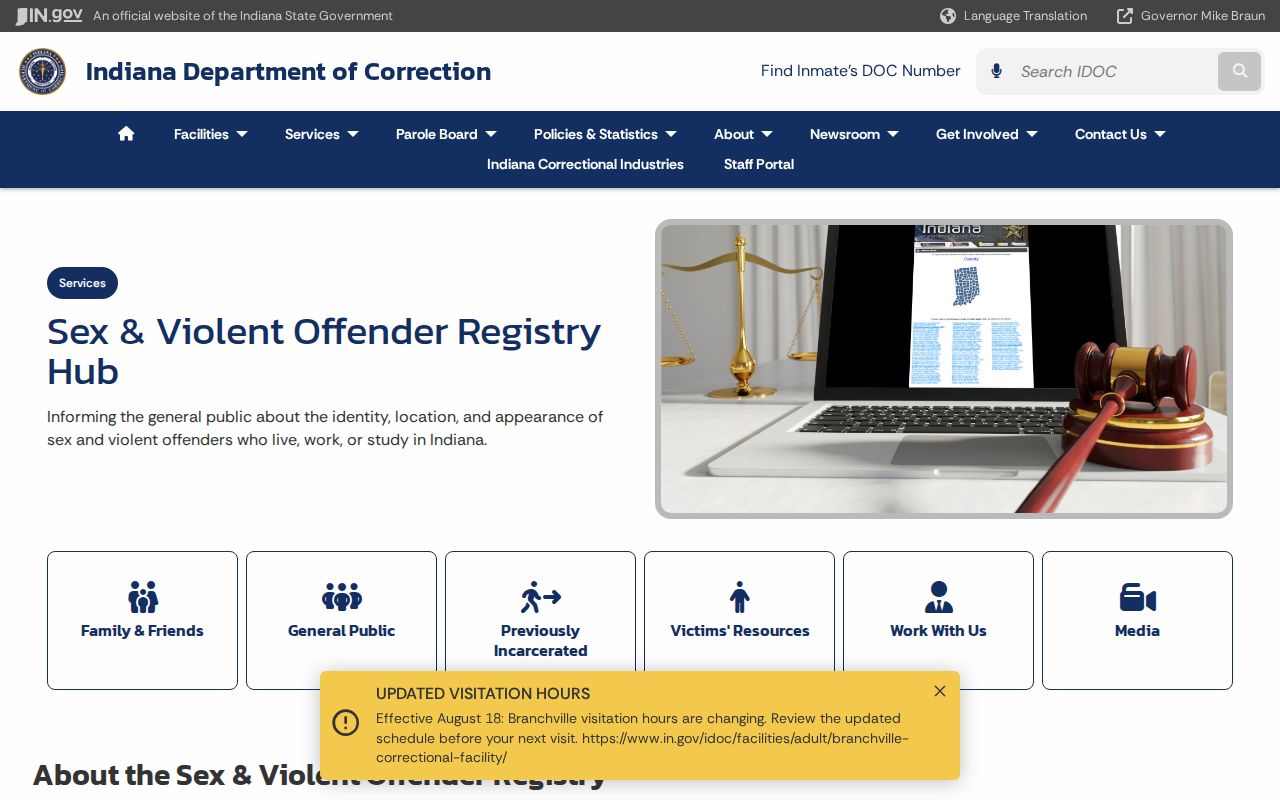
The registry’s stated purpose and displayed fields should guide anyone interpreting a public entry.
| Route | What it can answer | Boundary |
|---|---|---|
| Official custodian record | A filed deed, public case event, parcel entry, or eligible vital record | Use the office’s field meanings and access rules. |
| Commercial data compilation | May combine public filings with purchased contact associations | Can be stale, merge names, or repeat information outside its original context. |
| Protected or restricted record | Only what the law allows a requester to see | Do not try to bypass a seal, confidentiality flag, or eligibility rule. |
Indiana Adoption Records Use Official Forms
A birth-parent search has a formal route in Indiana. Adoption records do not have a general public name index, so an ordinary birth-certificate request may not answer the question. IDOH Adoption Services handles the state’s adoption-history and non-identifying-information process under Indiana Code 31-19. The right request depends on the person’s role and the record sought.
Begin with the current forms and eligibility notes on the Indiana Vital Records site. The order page gives a 120-day processing estimate for adoption services, though the current instructions should be checked before sending papers. A family member who wants to reconnect should use this lawful process rather than trying to infer a protected identity from unrelated public records.
For a person who is not adopted, vital indexes and obituary records can still help place a family event in time. They do not replace the statutory adoption route when that route applies.
Indiana Legacy Directory and Newspaper Indexes
The Indiana State Library’s Indiana Legacy index brings together searchable references to marriages, newspapers, obituaries, cemeteries, yearbooks, military material, and other collections. The index tells a researcher where a name appears; the contributing library or archive may hold the page image or copy. Coverage varies by collection, so read the date range shown in each result.
The State Library Genealogy Collection has more than 40,000 print items, county guides, cemetery transcriptions, family histories, and research help. Hoosier State Chronicles offers free newspaper searching, while INSPIRE provides licensed resources through participating libraries. A local library can identify its own newspaper microfilm, obituary indexes, school yearbooks, or cemetery records. These sources are especially useful when an official current portal has no historical name index.
Use a directory, yearbook, or obituary as a dated lead. Compare it with a county record before treating a name, address, or family link as settled.
When Indiana's Online Record Search Ends
County systems differ in vendor, image access, and starting year. If a deed search comes up short, ask the county recorder about the grantor and grantee indexes, book and page references, plat books, and older volumes. If the needed court document is not linked in MyCase, the county clerk can explain whether it is available at a public terminal or by copy request. A State Library county guide or an IARA catalog search can point to microfilm and archive holdings.
An APRA request works best when it names an existing record with reasonable particularity. An office must acknowledge an oral or in-person request within 24 hours and a mailed, faxed, or emailed request within seven calendar days. Those are response times, not guaranteed production dates; the agency has a reasonable time to produce records. It need not build a new list to answer an open-ended question. Inspection and search are not charged, though copy and electronic-access fees may apply.
When no online index exists, the useful next step may be a counter terminal, a mailed form, a library reference desk, or an archive inquiry. Note which county, name spelling, and date span you searched so the next office can pick up the trail.
Note: IARA encourages an appointment because staff retrieve records for the reading room; its current public hours are Monday through Friday, 9 a.m. to 4 p.m.
Indiana's Recent Public Records Changes
Indiana changed public access to birth and stillbirth registrations on July 1, 2025. House Enrolled Act 1148 set the opening point at 99 years, replacing older State Library guidance that described a 75-year period. Use the current statute and IDOH instructions when deciding whether a record is open; an older handout may still show the former rule.
Another change took effect January 1, 2026: enforcement of the Indiana Consumer Data Protection Act for covered private businesses. The law does not apply to state or local public agencies and does not erase a deed, court record, or voter record held by a government office. Indiana’s newer parcel data releases also improve statewide map context, while the county assessor and recorder remain the custodians for current tax and title records.
These changes affect access and discovery, not the meaning of a record. Keep the date of a search and verify current rules with the office that holds the file.
Indiana's Historical Resident Directories
The State Library lists an Indianapolis directory from 1855, and the joint digitized Indianapolis collection spans published volumes from 1855 through 2001. The broader Indiana City Directories Guide organizes print, microfilm, and online holdings by county. Haines criss-cross volumes add address-to-occupant entries from selected years between 1940 and 1988. For a full year-by-year account and help reading those entries, use the Indiana city directory collections.
A printed directory can name a householder, give an occupation, and list an address, but it may leave out children, lodgers, rural residents, and people not reached by the publisher’s canvass. Pair a year with census, deed, newspaper, or obituary evidence before drawing a family-history conclusion. The 1890 federal census is missing nationally, so Indiana researchers use the surrounding directory years and other records to bridge that gap.