
Indiana City Directory Holdings
Indiana does not have one complete statewide book of residents. The Indiana State Library arranges its city-directory guide by county, with some runs online and Ancestry access available inside the library. Local libraries and historical societies add books, microfilm, and year ranges specific to their communities. The table separates the especially well-documented Indianapolis example from those broader county-by-county holdings.
| Directory set | Years in run | Primary holdings | Ways to consult |
|---|---|---|---|
| Indianapolis city directories | 1855–2001, year gaps | IU Indianapolis, Indianapolis Public Library, Indiana State Library | Digitized pages, print, microfilm; check each year |
| Indianapolis Haines criss-cross runs | 1940–1988, with gaps | Indiana State Library guide holdings | Print or microfilm; selected runs online |
| Other Indiana city and county directories | Community-specific, many 19th- and 20th-century runs | State Library county guides, local libraries, Indiana Historical Society | Some online; ask about call numbers, microfilm, or in-library access |
| Polk Indianapolis suburban directories | 1957 through the 1980s, selected online years | Indiana State Library guide and listed digital collections | Check the guide for year-by-year access |
Coverage is not a promise of an unbroken annual sequence. The official guide marks gaps and changes in title or publisher; the Indianapolis digital collection describes the published run from 1855 to 2001, but its viewer still needs to be checked for the year wanted. For another Indiana city, use its county entry rather than carrying Indianapolis dates over to a different community.
Indiana City Directory Timeline
The Indianapolis sequence gives a clear view of changing publishers and formats. The State Library guide lists Grooms and Smith’s 1855 directory first, followed by a succession of early publishers before R.L. Polk became the familiar annual name in the late nineteenth century.
- 1855: Grooms & Smith’s Indianapolis directory is the earliest run listed in the State Library guide.
- 1857–1877: Howard, McEvoy, Hawes, Sutherland, Talbot, Dodd, Buell & Williams, Edward’s, Logan, Hutchinson, Bailey, Swartz & Tedrowe, and others appear across the listed years.
- 1878–1939: R.L. Polk annuals anchor the Indianapolis sequence, with Blue Books, social registers, and business directories alongside them in some years.
- 1940–1988: Haines address-based volumes add another way to search, with title and year gaps.
- 1989–2001: The digitized collection’s final span continues, but year-level availability should be checked in its viewer.
This is a timeline for Indianapolis, not a publication history for every Indiana city. In a different county, the local guide may show another publisher, a shorter run, or a different format.
Indianapolis City Directory Scans
The IU Indianapolis City Directory Collection describes all published Indianapolis directories from 1855 through 2001. IU Indianapolis University Library, Indianapolis Public Library, and the Indiana State Library collaborated on the collection. The scans cover residents and businesses, householders’ addresses and occupations, and complete business-directory material. The viewer presents page images, so a researcher turns or searches through a volume rather than querying a structured list of people.
The Indianapolis pages make it possible to compare a printed name and address across different years from a home computer. Begin with the year and section you need, then check the title page and printed page itself before copying a result into family notes.
The Indianapolis digital collection shows how a directory page is presented for reading and comparison.
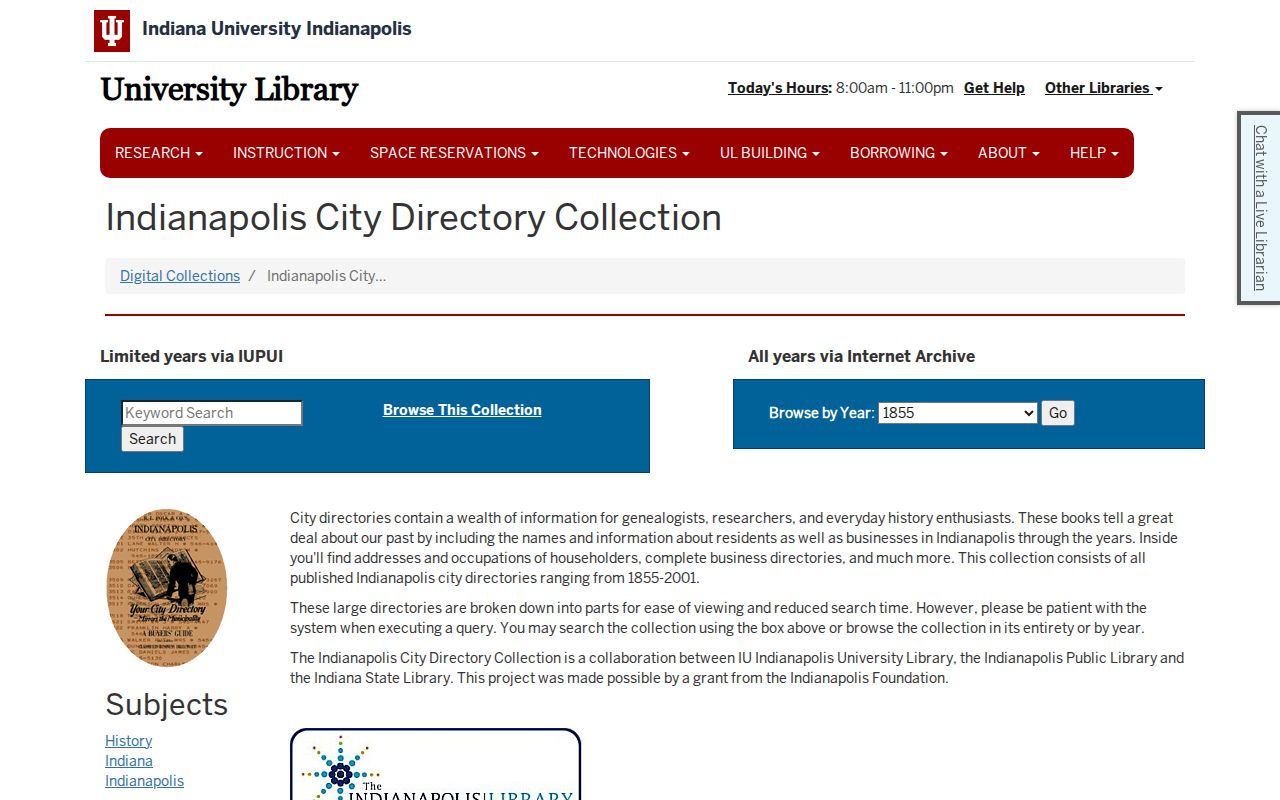
The scan can preserve the layout and surrounding listings, which helps distinguish a person entry from a business or street-index entry.
Indiana Haines Directory Runs
Haines volumes add an address-to-occupant bridge that the alphabetical pages alone do not provide. The State Library guide lists an Indianapolis Criss-Cross volume for 1940, runs in 1947–49 and 1951–61, and later metropolitan, city, and suburban titles from 1962 into 1988. The sequence has gaps, so a missing year should be treated as a missing source rather than proof that a household was absent.
A criss-cross volume reverses the usual route: begin with a street address to see the listed occupant or business, then use the alphabetical section to connect a name with an address and occupation. It is useful for tracing an address between deed dates, but it records a publisher’s canvass and cannot establish ownership. The State Library county guide and its detailed Marion County directory guide identify which years and formats are held.
Read an Indiana City Directory
An alphabetical entry commonly gives a surname, given name or initials, residence address, and occupation or employer when printed. A spouse or widow marker may appear, and a later listing can add a separate business address. Address sections may show a street number, surname or initials, and an indication of a household or business. Formats change by year and publisher, so treat the printed line as evidence of what the directory recorded, not as a complete household roster.
| Name | Surname, given name, or initials as printed |
|---|---|
| Occupation | Trade or employer, when the entry includes one |
| Spouse or widow mark | A spouse name or widow notation may appear; verify the volume’s key |
| Address | Residence street number and street, with original direction and abbreviation |
| Owner or renter mark | Only where that edition supplies a mark; do not infer one from an unexplained symbol |
- Criss-cross directory
- A street-address section that points from an address to a listed occupant or business; the alphabetical section can then help connect the name back to an address.
- Householder index
- The alphabetical name section used to locate a listed household head or resident. Its exact fields depend on the edition.
- Abbreviation key
- The publisher’s guide to short forms and marks. Check it before expanding “h,” “r,” “bds,” “wid,” or an owner/renter symbol.
Copy the publication year, page number, and exact street spelling with every note. If a symbol or name is unclear, return to the volume’s preface and key before comparing it with another year.
Indiana Library Directory Shelves
The Indiana State Library’s county-organized directory guide is the routing tool for towns beyond Indianapolis. It identifies local holdings, call numbers, online years, and Ancestry access inside the library. The State Library’s Genealogy Collection also includes more than 40,000 print items, county guides, indexes, cemetery transcriptions, family histories, military pension material, microfilm, and research consultations.
The Indiana Historical Society’s William Henry Smith Memorial Library holds selected city and county directories in books and microfilm, including material identified for Indianapolis, Evansville, and Lafayette. A local public library or county historical society may hold other runs. Ask the reference desk for the county guide, directory call number, format, and whether an appointment, reproduction charge, or donor limit applies before traveling.
The Indiana State Library Genealogy Collection page describes its statewide research materials and services.

For an Indiana city directory that is not online, the county guide can point to the in-person shelf or microfilm path.
Indiana Directory Maps and News
Directory entries make more sense when paired with sources that preserve a street’s earlier form. The State Library’s property-research guide recommends directories alongside deeds, Sanborn maps, newspapers, county microfilm, county histories, and atlases. It also recommends searching a newspaper with an address phrase, such as a house number plus street name, when the family name alone returns little.
Sanborn and Baist maps can help place a building footprint, material, use, street, and block number within editions from roughly the 1880s through the 1950s, depending on the city. State Library microfilm, the Library of Congress Sanborn collection, and the Indiana State Library’s links to IU scans provide different routes. For an address that changed, compare the directory’s map or address with a plat and map block before deciding the entries refer to different places.
When the question becomes who occupied one particular property over time, the deed-and-household workflow belongs with the Indiana previous residents search.
Trace Indiana Families by Directory
A directory provides a dated snapshot between census years, while census schedules add household context. Indiana holdings include federal census years 1820–1880 and 1900–1940; the 1890 census was destroyed nationally. The directory’s printed address and name can help select a census district or compare family members, but directory years do not align neatly with every census. Record the edition and page for each entry so a later researcher can repeat the search.
- Find the person in one available year and copy the name, address, occupation, and any spouse or widow notation exactly.
- Check the publisher’s key, then look in the street section where a criss-cross run exists.
- Repeat in nearby directory years and note each move or change in the printed name.
- Compare the address and household with the nearest available census year, keeping the 1890 gap in mind.
- Use a newspaper, obituary, cemetery index, or probate record to test a possible move, death, or family link.
If someone disappears from one volume, the reason may be a move, a changed spelling, an edition gap, a limited canvass, or omission from that publisher’s listings. Compare another year and another source before drawing a conclusion. Hoosier State Chronicles provides free historical newspaper searching; Indiana Legacy indexes obituaries, cemeteries, marriages, yearbooks, and other records, while images remain with the contributing institution. Those sources can add context, but a directory entry by itself does not prove that a person owned or continuously occupied a property.