
What an Indiana Resident Lookup Can Confirm
Indiana has no single public file for every question. Shared state indexes sit alongside county tax, deed, marriage, probate, and election files. Voter records confirm a person’s registration; parcel cards describe owners and places; court entries describe cases.
| Record set | Question it can answer | Starting office or index | Access route |
|---|---|---|---|
| Parcel and tax card | Titled owner, parcel, situs and owner mailing address | County assessor/auditor; DLGF Tax Bill Search | Public parcel data; features and copies vary by county |
| Voter registration | A person’s registration status, polling place and county | IndianaVoters; county election office | Individual self-lookup; file access is restricted |
| Trial court case | Party role, court, case type, events and public disposition | MyCase; county clerk | Public cases online; official file with clerk |
| Birth, death, marriage, adoption | Event details or a permitted historical index match | IDOH, local health department, county clerk, Indiana Legacy | Index and certified-copy access have separate rules |
| Probate and guardianship | Public estate parties, filings, and case timeline | MyCase, county clerk | Public portions only; clerk holds the official file |
| Business or professional record | Filed role, license number, status, or public affiliation | INBiz; PLA Search & Verify | Online search; some prints or documents cost |
| Obituary or yearbook index | Historical community links, relatives, or former names | Indiana State Library; Legacy and local libraries | Coverage varies by collection |
Start with the county assessor for ownership, MyCase for a case, and IDOH plus the event county for vital records. Marion County shows the situs/mailing-address split; other portals vary.
Search Fields in an Indiana Resident Lookup
MyCase searches Indiana Odyssey trial-court records by party, case, attorney, court, type, status, or file date. Sounds-like can surface name variants, but a hit is only a lead. Narrow by county or date; large results may trigger a CAPTCHA.
The MyCase party search is the state portal; Judicial Branch search tips describe its controls.
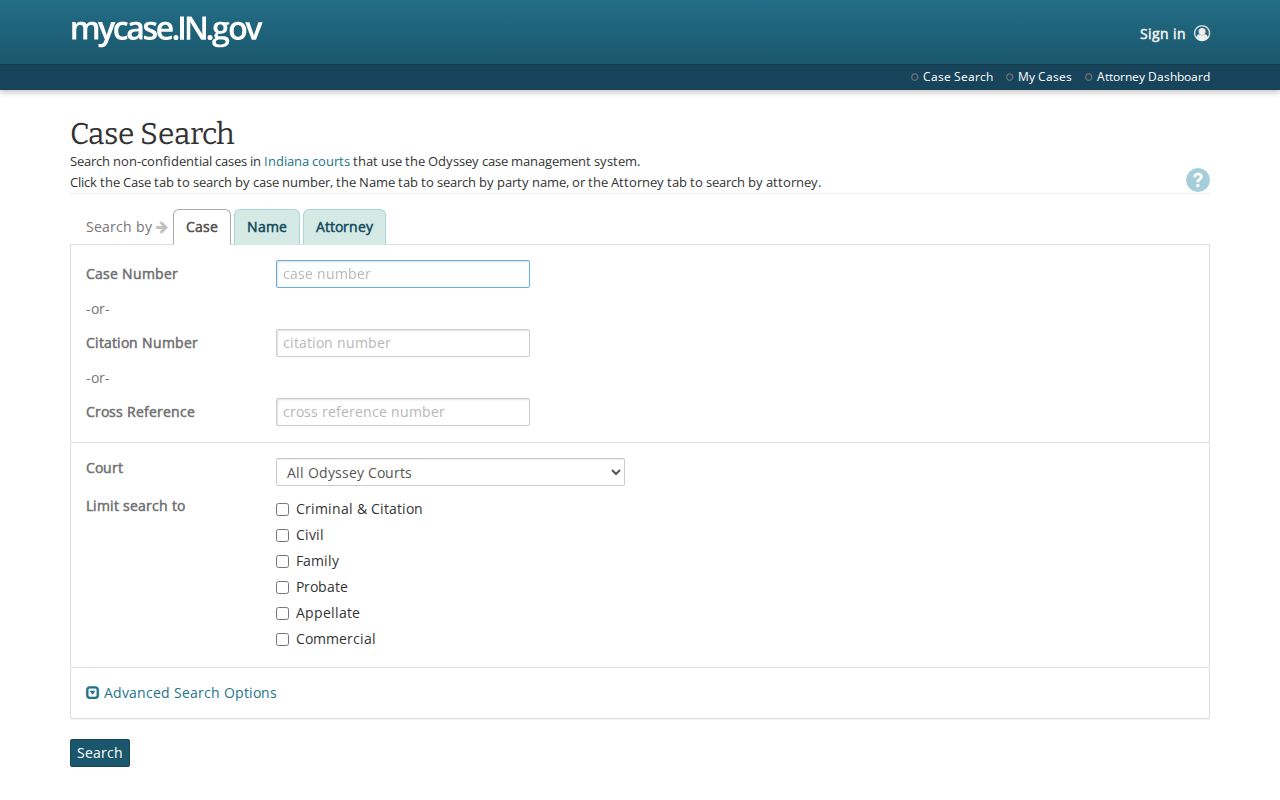
Keep the case number. MyCase may contain errors or omissions; ask the clerk for older public documents not linked online.
| MyCase field | Type or need | How to use it |
|---|---|---|
| Case, citation, or cross-reference number | Text; alternate case routes | Use one identifier. Hyphens or leading zeroes may be omitted; some case formats accept wildcards. |
| Party last name or business | Required for party search | Add first or middle name and, when useful, date of birth to narrow. |
| Party first/middle name, date of birth, sounds-like | Optional name fields, date, or control | DOB narrows results but is not generally shown in full; sounds-like checks spelling variants such as Shepherd/Shepard/Shephard. |
| Attorney name or bar number | Last name plus first/middle, or number | Use the Roll of Attorneys if the bar number is unknown. |
| Court and case type | Optional dropdowns | Choose a court; available civil, criminal, family, probate, and other types vary with it. |
| Status and file-date range | Optional status and date filters | Select open or closed and use a start date, end date, or both. |
A typical result exposes a useful inventory of fields:
- Party name and role, case number, court, type, and filing date.
- Attorney details, dated events, public orders, documents, disposition, and status; some cases show balances or payments.
- A missing document link calls for a clerk inquiry; restricted cases stay closed to ordinary search.
Verifying a Name in an Indiana Resident Lookup
A common name may point to several people, or one person may appear under an initial, former surname, or spelling variant. Note the county, period, middle name, and known address. Compare records; one name match is not identity proof.
- Search the county assessor or DLGF tax search; keep parcel, property address, owner mailing address, and tax year distinct.
- Try the name and sensible spelling or former-name variants in MyCase; narrow by county, court, date, or case number.
- Use a voter result only for the person’s own confirmation, or ask the county election office about a specific permitted record.
- Use marriage, death, obituary, deed, or probate records to check a family link, then ask the custodian for an official copy.
- Docket
- The court case record: number, parties, dated events, and public filings or orders.
- Index vs. image
- An index locates a record by name or date; an image is a scan of the document, if available.
- Certified copy
- A copy authenticated by the custodian, unlike an index entry or ordinary screen print.
Indiana Resident Lookup and the Voter Self-Check
IndianaVoters covers all 92 counties. People can check registration and polling place, not search by street. A no-match may reflect spelling, name change, county, birth date, or status. Enter the recorded name without a Jr./Sr. suffix.
The voter form and county browse controls have these documented inputs:
| IndianaVoters control | Type or need | Notes from the portal |
|---|---|---|
| First name and last name | Text; both required | Enter the recorded spelling; leave off a suffix. |
| Date of birth | Date; required | Used with the name for an individual registration search. |
| Current registration county | County dropdown; required | Select the Indiana county on the record. |
| Indiana driver’s license number | Optional text | Alternate identifier for the voter’s own search. |
| County, precinct, split precinct | Dependent browse dropdowns | County browse narrows to precinct and then split precinct. |
| Submit / Clear | Buttons | Returns a match or no-match and registration or polling details; Clear resets fields. |
For a correction, contact the county election administrator. A permitted computerized data request uses VRG-24, which asks for an eligible requester category and data product. Other requesters may receive a restricted statewide file with birth date and gender redacted; the qualifying annual full file is listed at $5,000. This is not a household search.
The IndianaVoters portal shows the statewide self-check for an individual record, not an open resident list.
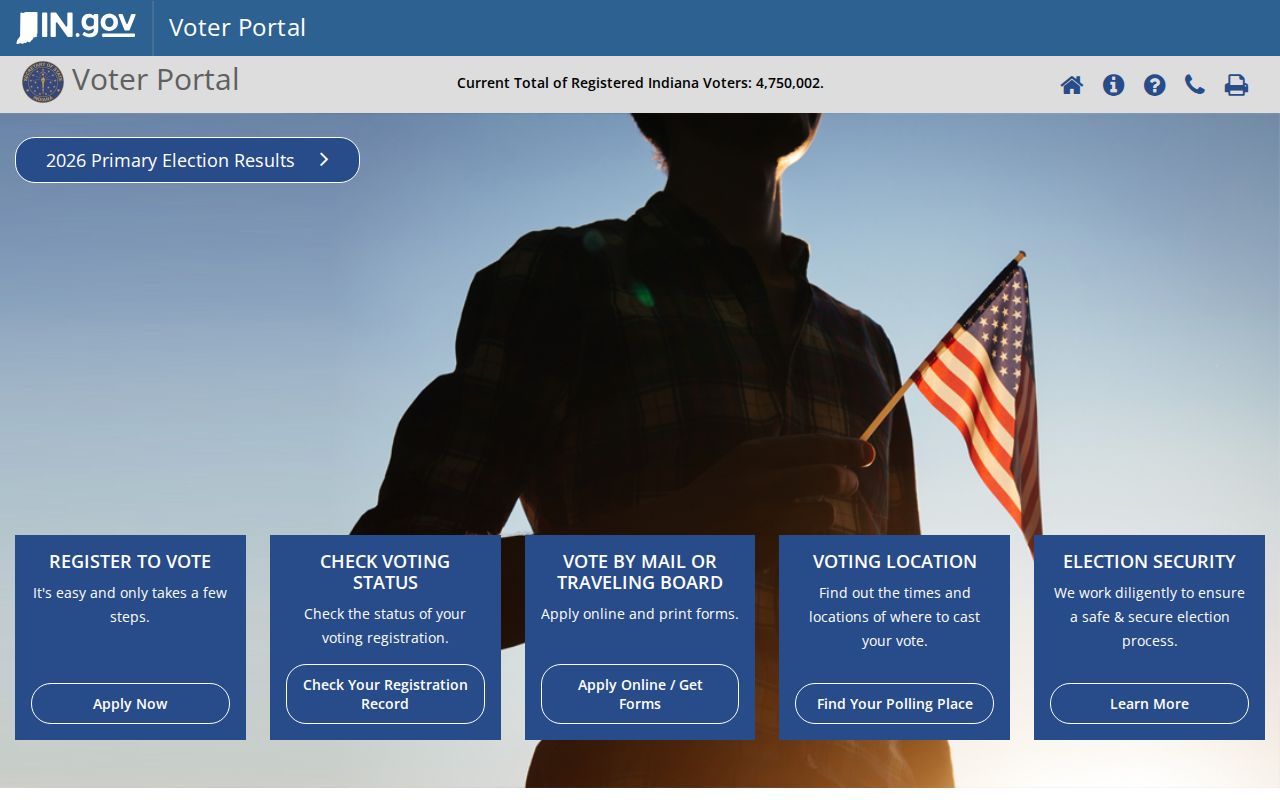
Returned mail can affect status, and a record can lag a move. The Address Confidentiality Program can flag a participant’s voter data from public inspection.
Indiana Vital Records: Copy and Index Access
IDOH centrally records births from October 1907 and deaths from 1900; earlier events are local. An index, obituary, and certified certificate differ. Since July 1, 2025, birth and stillbirth records open after 99 years; earlier copies generally require a qualifying relationship or direct interest. Adoption has separate rules.
The event county health department offers walk-up service. IDOH has no walk-in counter; it accepts mail and phone orders and online orders through its approved VitalChek page. Phone: 866-601-0891. Fees are $10 first birth copy, $8 first death copy, and $4 each additional. Processing varies by record and route.
Form 49606 asks for event, applicant, delivery, and identity details; non-certified death records redact the Social Security number. IDOH marriage data starts in 1958; older events go to the county clerk. Form 54764 costs $8 per date and estimates six to eight weeks. Divorce files are at the county court or clerk.
Indiana Legacy or a State Library index can locate a name; the contributor holds the image or certificate. An earlier missing result calls for an event-county search.
Indiana Adoption History’s Official Route
A birth-parent search belongs with Indiana Adoption Services, not a public birth index. State forms cover adoption history and non-identifying information under eligibility and consent rules; the order page estimates 120 days. A public index does not replace this confidential process.
For family history, the State Library, Legacy, county archives, and local libraries can point to newspaper, yearbook, cemetery, and directory indexes. These can suggest a name change, but do not override access rules or establish current contact details.
Probate Clues and Obituaries in Indiana
For an heir or family link, compare probate, an obituary, and a deed transfer. MyCase may show an estate party or hearing; the clerk explains access to public papers. Sealed financial or medical material stays restricted. Newspapers and genealogy collections add context.
An obituary can point to relatives, a former town, or service location, but it is not a certified record. Check dates against a death index and save the source so namesakes are not merged.
For a former classmate, match a yearbook or newspaper to a known school and year. The Indiana directory collections add context; Indianapolis scans are regional, not a statewide roster.
Indiana License and Business Search Records
PLA Search & Verify checks a license number, a person’s full name, or a facility/business name. Search is free; a print is $1 with an account or $1.43 by card. Download fields include name, license, address, dates, and status. Home telephone, personal email, and Social Security numbers are confidential.
The PLA Search & Verify image shows the state’s license-check route. A license record can support a professional affiliation or status check, but its public address is not automatically a home address.
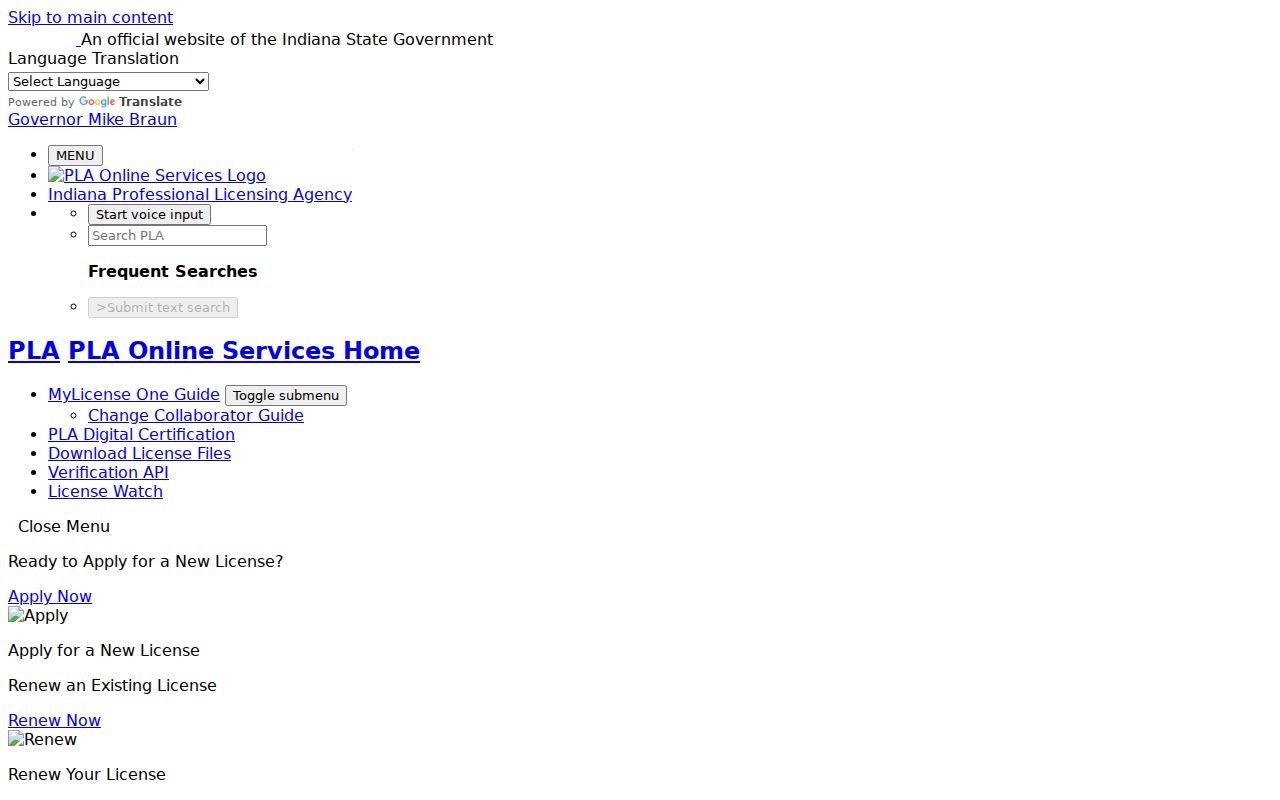
Compare the license number and public status, then note the issue and expiration dates shown for that credential.
INBiz can show filed business names, registered agents, principal offices, officers or managers when supplied, status, and document images. A registered agent or principal office is an organizational connection, not proof of a person’s residence. Confirm the filed role and date with the Secretary of State’s record before drawing a conclusion.
An Indiana Resident Lookup When Online Search Leaves a Gap
The Indiana Access to Public Records Act allows inspection or copying of existing, non-exempt records. It does not make an office create a resident list or answer a broad question. Name the custodian, record, person or parcel, and useful date range with reasonable particularity.
An oral, in-person, or telephone request is acknowledged within 24 hours; mail, email, or fax within seven calendar days. Production is within a reasonable time, not those windows. State paper copies may cost 10 cents a page; inspection and search cannot be charged. County copy fees follow statutory actual-cost limits. For an unlinked court document, ask the county clerk; route deeds to the county recorder, tax cards to the assessor, and other records to their own custodians.
Privacy Limits on an Indiana Resident Lookup
Exceptions cover juvenile, adoption, sealed, expunged, protected-person, motor-vehicle, and restricted vital information. The Address Confidentiality Program gives eligible survivors a substitute mailing address and voter-record flag. A trained advocate can explain its limits.
The Indiana Consumer Data Protection Act began enforcement in 2026 for covered businesses, with public-agency exemptions. It does not erase official records. Commercial copies can be stale or merge similar names; opting out of a copy does not amend a source file. For a wrong parcel, voter entry, case, vital, license, or business record, contact its custodian about correction or appeal. The state’s Attorney General summary describes the law.
Personal research. Keep an Indiana resident lookup to lawful purposes such as family history or checking a public record. Under IC 35-45-10-1, stalking involves a repeated or continuing course of harassment that causes reasonable fear, intimidation, or threat; public access is not permission to pursue or harm someone.