
Indiana Previous Residents by Era
Different records answer different parts of an address-history question. County deeds can document legal transfers, but they do not by themselves identify everyone who lived inside. Directories and census schedules add occupants and household detail; maps and permits can help place the structure in time. The coverage below describes the Indiana and Indianapolis materials documented in the research, with county-specific limits kept visible.
| Record source | Coverage years | Keeper or location | Evidence it offers |
|---|---|---|---|
| County deed books and index | County-specific; many books reach the 19th century, online cutoff varies | County recorder, county books, selected affiliate-library collections | Grantor, grantee, recording date, legal conveyance |
| Indianapolis city directories | 1855–2001 overall, with year gaps | IU Indianapolis, Indianapolis Public Library, Indiana State Library | Listed residents and businesses, addresses, occupations |
| Haines criss-cross directories | 1940–1988, with gaps and title changes | Indiana State Library print or microfilm | Address-to-occupant or business listings |
| Federal census | Indiana holdings: 1820–1880 and 1900–1940; 1890 lost | U.S. Census and NARA records, State Library books or microfilm | Household members, ages, occupations, birthplace, geography |
| Sanborn and Baist maps | City editions, roughly 1880s–1950s | Indiana State Library, Library of Congress, IU scans linked by the State Library | Building footprint, material or use, street and block context |
| Permits and code cases | Local start year not located statewide | City or county permit office and public portal | Construction, alteration, violation, applicant, or address dates |
| Newspapers, obituaries, probate | Title- or county-specific, often 19th century to present | Hoosier State Chronicles, libraries, IHS, county court or archive | Moves, deaths, heirs, estate addresses, notices |
For a recent transfer, begin with the county assessor or auditor card and follow its parcel and legal description into the recorder’s index. For an older occupant, use the directory or census year that matches the period, then add a map or local notice as a check. The county determines deed-image coverage, permit history, and which records remain in books, at a counter, or on microfilm, so the table is a route map rather than a promise that every year is online.
Indiana Resident Address Clues
Before looking for previous residents, write down the address exactly as it appears today and note its direction, street type, municipality, and county. Then capture the parcel number and legal description from the assessor card. A situs address is the parcel’s physical location; a mailing address is where tax notices go and may belong to an owner who lives elsewhere. Keeping those two lines separate prevents a mailing address from being mistaken for an occupant.
Check whether the street name, number, direction, or parcel changed over time. Indianapolis directory maps and old plats may use an earlier number than the current assessor. Elsewhere, annexations, renamed roads, rural-route addresses, and city or township boundaries can shift the record trail. If a current address returns nothing, compare the legal lot and map geography before deciding that no prior resident appears in the record.
Indiana Deed Chain for Previous Residents
Start with the current parcel card, but use the county recorder’s instrument as the evidence of a transfer. The assessor can supply the current owner, parcel number, prior-transfer row, map or plat reference, and legal description. In the recorder index, search the current owner as grantee around the transfer date, open the purchase deed if available, and note its document number, recording date, parties, legal description, consideration, and instrument type.
- Record the present parcel number, owner, legal description, and transfer row from the county property card.
- Search the recorder index for that owner as grantee near the transfer date; save the deed number or book and page.
- Read the deed and compare its legal description, subdivision, lot, and block with the parcel being traced.
- Search the seller as grantee to locate the earlier conveyance, then repeat backward one transfer at a time.
- When the online run ends, ask the recorder about older indexes, deed books, plat books, or microfilm.
- Grantor and grantee
- The grantor transfers an interest; the grantee receives it. Search both sides when following a deed backward.
- Chain of title
- The linked sequence of recorded transfers for a parcel, followed through matching legal descriptions and parties.
- Legal description
- The written parcel description, such as a lot and block or metes-and-bounds calls. It can remain useful when a street address changes.
- Criss-cross directory
- A directory section that starts with a street address and lists an occupant or business, complementing the alphabetical name section.
- Enumeration district
- The geographic area covered by a census taker. Use the address and census year to find the right district before comparing households.
Some Indiana county systems provide online index or image searches, while others require a counter, staff help, or older books. Recorder duties and contact routes are summarized by the Indiana State Board of Accounts; county vendors and online cutoffs vary. If the result is missing, ask for a specific deed, plat page, or index range rather than a newly compiled list of everyone who lived there.
Indiana Resident Deed Search
Once a deed names the seller, use that party as the next grantee. A second search may reveal the seller’s own purchase, but a matching name alone is not enough. Compare middle initials, spouse or agent names, instrument date, subdivision and lot, legal-description wording, and nearby parcels. Keep the document number even if an image is unavailable or paywalled, then ask the county recorder how to inspect or order that existing record.
The line can branch. A trust, corporation, estate, sheriff’s deed, tax sale, split parcel, or merger may stand between two ordinary sales. Follow each reference to its own instrument and record the fork instead of forcing every name into a straight sequence. A recorded deed answers who conveyed title; a directory or census is still needed to test who occupied the building.
Indiana Residents in Criss-Cross Runs
Directories fill the years between deed transfers. For Indianapolis, the State Library guide lists Haines criss-cross coverage beginning with 1940, additional runs in 1947–49 and 1951–61, and later metropolitan or city-and-suburban titles through 1988. Gaps and title changes matter: do not read an unlisted year as evidence that an address had no occupant.
Pair the address listing with the alphabetical name section, where available, to compare occupation and residence details. The complete Indianapolis collection spans 1855–2001 overall, and its years should be checked one by one. The Indiana city directory collections page covers publishers, library holdings, and how to read a printed entry; here, the directory is one layer in the backward history of a single property.
The Indiana State Library’s property-research guide recommends directories as part of house-history work.
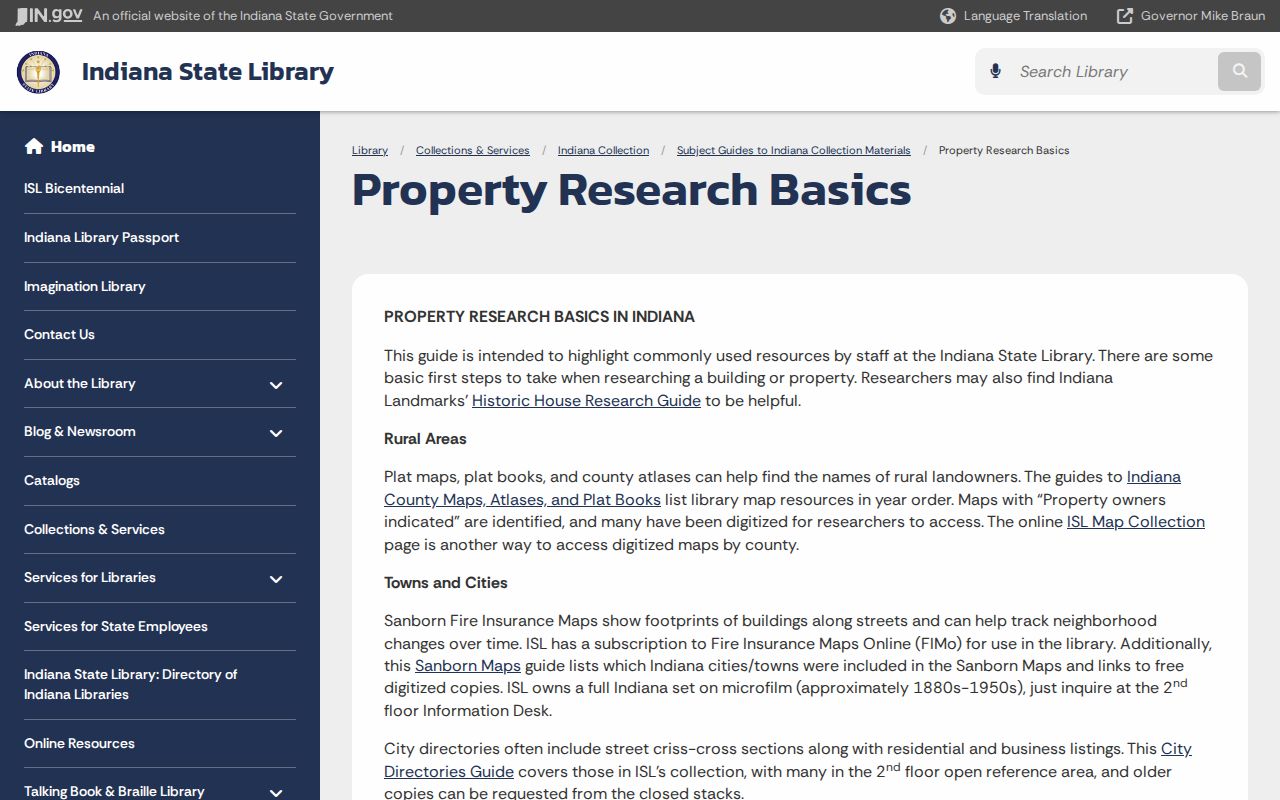
Its suggested combination of directories, deeds, maps, newspapers, and local records keeps the address trail tied to more than one source.
Indiana Residents and Census Years
Census schedules can show a household that a deed cannot: names, ages, occupations, birthplaces, and the household’s recorded location. Indiana holdings documented here include 1820–1880 and 1900–1940. The 1890 federal census was destroyed, leaving a national gap between those decades. Federal schedules open under the 72-year release rule, and books, microfilm, and indexes offer library routes as well as online search.
- Choose a directory year close to the period of interest and copy the address and household name as printed.
- Find the nearest available census year and identify the relevant enumeration district or geographic area.
- Compare household members, ages, birthplace, and occupation, allowing for a move between the two dates.
- For the 1890 gap or years between schedules, use a nearby directory, deed, newspaper, or local history source.
A directory and census entry need not match word for word. A directory may use initials or a spouse notation, and a household could move between the two publication dates. Save the census place and district as well as the names so another search can reproduce the result.
Indiana Residents on Sanborn Maps
Sanborn and Baist editions can add a physical layer to the people trail. Depending on the city and edition, they show a building footprint, construction material or use, street and block numbers, and later alterations. The Indiana State Library holds a statewide Sanborn set on microfilm, roughly from the 1880s through the 1950s; Library of Congress and IU scans provide free digital copies where listed.
Use a map to test whether an old directory address sits on the same lot or block as the present parcel. A map can date a structure or show how a block was laid out, but it does not identify every occupant or establish who held title. The State Library’s Sanborn map collection page explains its microfilm, city coverage lists, and links to digitized holdings.
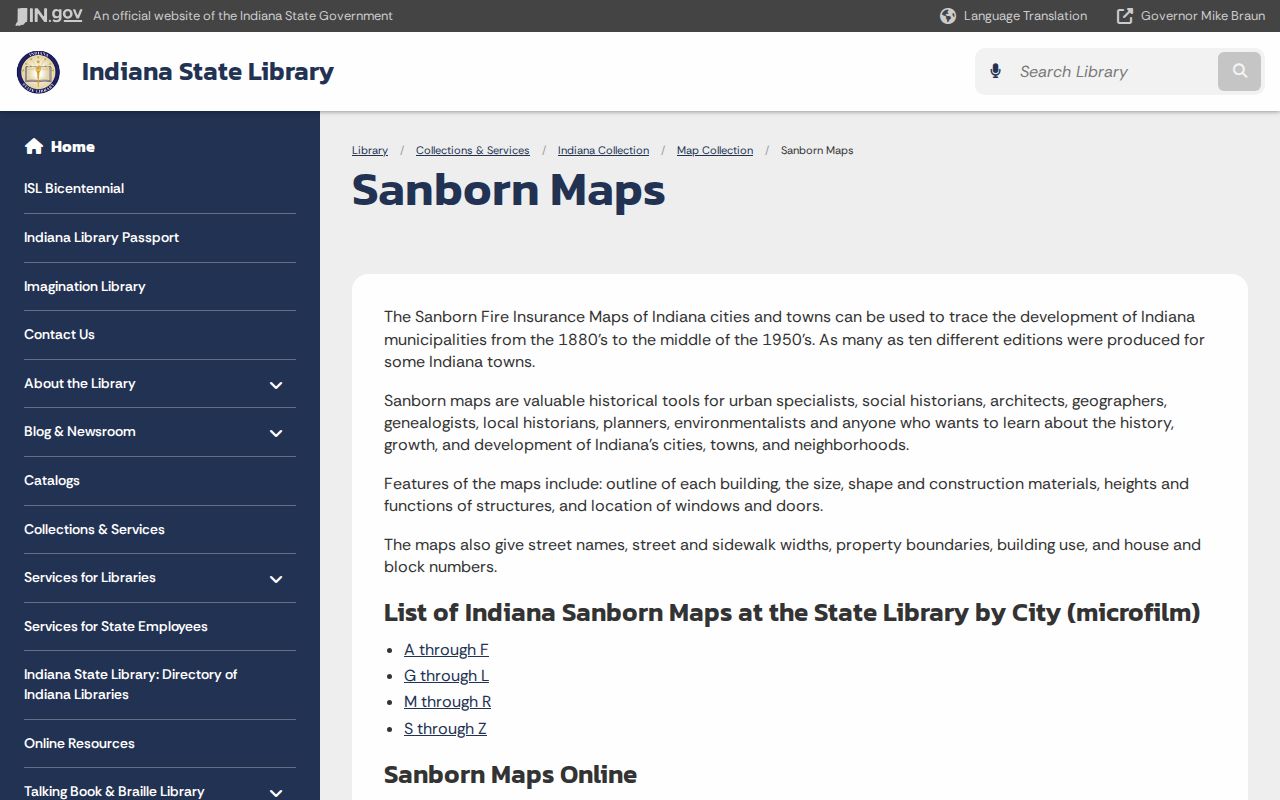
Compare the map’s block and street labels with the directory or plat before connecting an earlier number to the present address.
Indiana Address Records and Street Names
An address can change while the parcel remains the same. Indianapolis directory maps and old plats use historic street names and numbers; the State Library guide lists Polk maps for 1880, 1881, 1883, and examples from 1894–1909. Sanborn block numbers and subdivision plats can help bridge an older address to today’s parcel. Outside Indianapolis, annexations, renamed roads, township lines, and rural-route addresses can create similar breaks.
When an exact modern-address search fails, test the street name, direction, number, legal lot, and block against the older map. Do not infer a particular renumbering year statewide: the research documents the mismatch risk, not one date that applies to every Indiana city. A changed address is one reason to keep the legal description beside the directory transcription.
Indiana Residents, Permits, and Probate
Local permits and code cases can date construction, alterations, or a reported problem at an address. Their coverage start year was not located statewide, so ask the city or county permit office about older cards and search any public portal by address, date, status, or project where those fields are offered. A permit date is not an ownership transfer, and an applicant’s name is not automatic proof of residence.
Newspapers may report a move, sale, marriage, death, or estate notice that helps connect a person with an address. Indiana State Library guidance suggests trying the address as a phrase, such as a number with its street name. Hoosier State Chronicles is a free newspaper search; State Library holdings, INSPIRE at participating libraries, and local historical societies add other titles or microfilm. Obituaries and probate can identify heirs, an executor, or an estate address, but each claim should be checked against the underlying record when available.
Indiana Previous Residents Across Records
Owners are only part of an address history. Directories can show listed residents, while census schedules add household members and family context for available years. A name that appears in both is stronger evidence of an association with the property than either source alone, but it still needs the date, street number, and geography checked. City directories are publisher records, not a deed or a complete count of everyone in a building.
For an older family trail, compare a possible move with an obituary, cemetery index, marriage record, or county probate file. Indiana Legacy indexes several of these record types, but the image or copy remains with the contributing institution. Local libraries, church archives, and county historical societies may hold registers or microfilm that are not online. Record which years and spellings were searched, including unsuccessful searches, so a gap is clear rather than mistaken for proof that nobody lived there.
Lawful personal use. Use previous-resident research for family history, estate questions, and curiosity about a property. Do not use it to track or harass a living person, and respect confidential records and the rules of each archive.